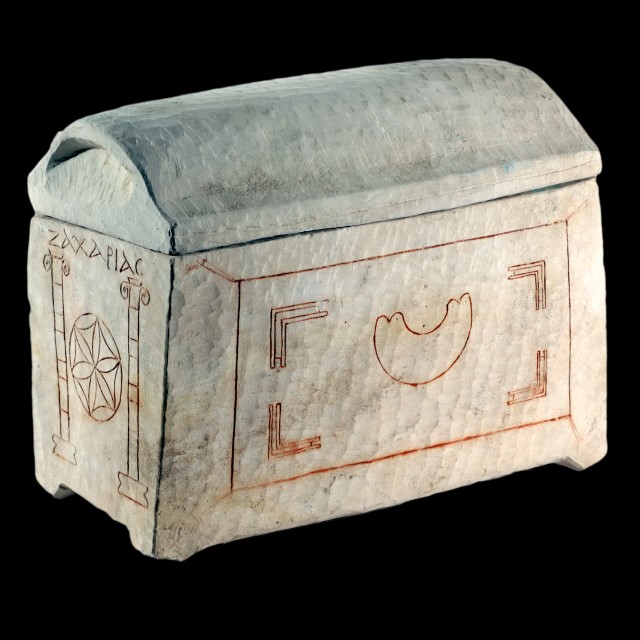
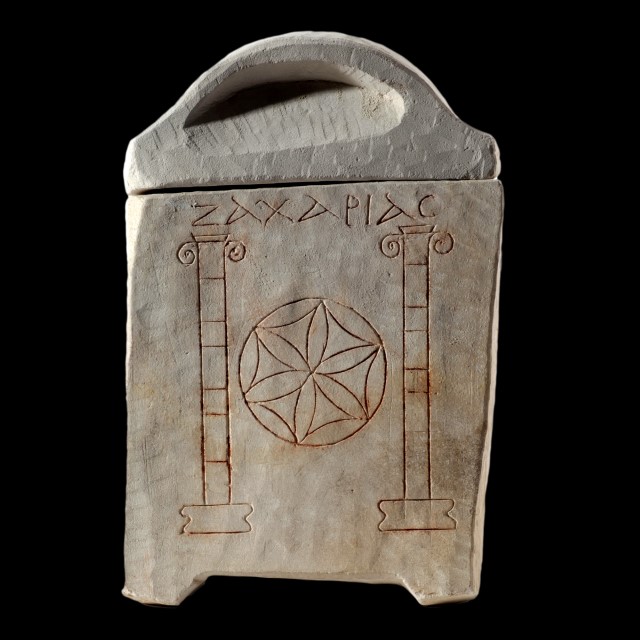
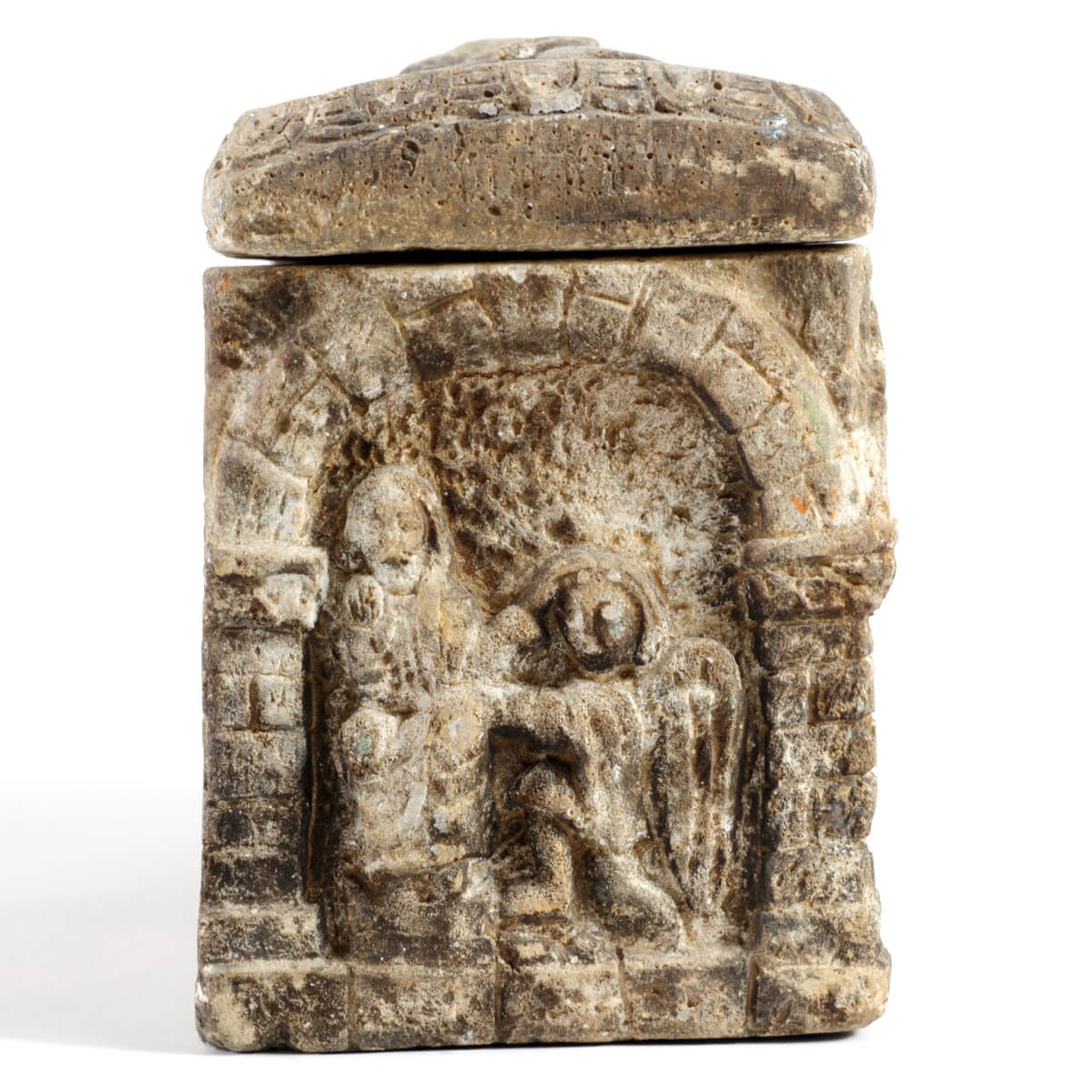
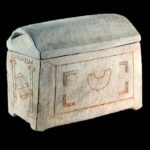
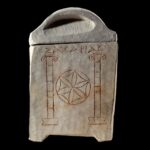
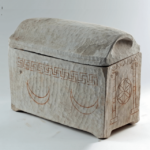
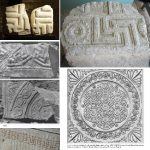
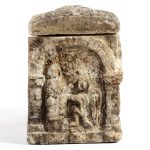
The ossuary of Ζαχαρίας (Zacharias = Zechariah), decorated on all four sides with unique motifs
barcode
73540
Site item id
19638
Collection name
Item period
The Ossuary of Zacharias (Ζαχαρίας = Zechariah)
The ossuary of Ζαχαρίας (= Zacharias, Zechariah) is unique in its features and decoration. It differs from the overwhelming majority of the thousands of Jewish ossuaries from the late Second Temple period discovered in Jerusalem and its immediate surroundings. Its singularity is not incidental but deliberate, reflecting a carefully conceived iconographic and commemorative program. It is unique in its style of ornamentation, in the artistic motifs on its four sides, in its symbolism, and in its inscription. The ossuary is dated to the first half of the first century CE. As far as is known, it was discovered in East Jerusalem or nearby.
The ossuary was purchased from the licensed antiquities dealer Kamal Imam of East Jerusalem several decades ago. It constitutes part of the largest and most important private ossuary collection in the world, held in private hands, and was exhibited in two international exhibitions in the USA in 2024 and 2025 (with the approval of the Israel Antiquities Authority).
Whereas most ossuaries served as “containers” for preserving the bones of Jews interred within them, placed in niches or adjacent to the walls of family burial caves, the ossuary of Zechariah seems to have been intended for something more: a commemorative “monument,” embodying within the community of the deceased the memory of a known and honored man, perhaps even regarded as holy within his community. The very decision to lavish decoration and resources on all sides of the box confirms that it functioned not merely as a receptacle but as a deliberate memorial to a figure of exceptional standing.
Decoration on All Four Sides of the Ossuary
The vast majority of ossuaries from the Second Temple period were entirely undecorated, or decorated only on one side, usually with rosettes or geometric motifs. Since ossuaries were placed against walls in burial caves, or inside burial niches, multi-sided decoration was unnecessary.
By contrast, the ossuary of Zacharias (Ζαχαρίας) is richly decorated on all four of its sides. This highly unusual choice cannot be explained by convention or ornament alone; it is a clear indicator of intent. It was intended to be viewed from different directions, in order to preserve a public memory that extended beyond private family remembrance. This may point to the deceased having been a person of exceptional communal and/or religious significance.
Art and Technique
The decoration of the ossuary was executed with great precision and extraordinary symmetry, by a professional artisan. Unlike most ossuaries, where designs were carved deeply into the stone or cut in relief, the decoration here was created using shallow incisions made with a ruler and compass, filled with brown pigment. This technique, extremely rare in the ossuary corpus, produces a strong contrast with the light-colored limestone surface.
The investment in numerous decorations across all four sides of the ossuary confirms that this was a special commission. Its production required careful planning and significantly greater expense — a factor that alone testifies to the special status of the deceased and the unusual importance of perpetuating his memory.
Provenance
The ossuary is indisputably ancient, with no scholarly dispute regarding its authenticity. It was purchased several decades ago from the licensed antiquities dealer Kamal Imam, long regarded as one of the most reliable antiquities dealers in Jerusalem, and has since formed part of the largest and most significant private collection of antiquities in Israel, which includes dozens of ossuaries.
Nearly 99% of all ossuaries discovered in the Land of Israel have been found in Jerusalem and its immediate vicinity (including Jericho to the east), and not in other regions. It is therefore highly reasonable to accept the original report of the dealer who first acquired the piece, that its provenance was East Jerusalem or nearby.
Furthermore, very few ossuaries recovered from properly excavated tombs have yielded material evidence directly linking them to the occupation or identity of the deceased. Names of the deceased — and, in rare instances, their profession or city of origin — were inscribed on the ossuaries themselves, almost never on the walls of the burial cave. In fact, almost no archaeological finds from controlled excavations of tombs from this period have provided supplementary information about the identity of the deceased or related matters. In this sense, the Zechariah ossuary provides more than the usual: it not only preserves a unique name but couples it with a rich, coherent decorative program.
Although the ossuary did not come from a controlled excavation, its significance is in no way diminished. The inscription and iconographic program themselves provide the decisive evidence regarding the identity of the deceased. In fact, even in cases where ossuaries were recovered from documented tombs, virtually no additional information was obtained about the individuals interred, unless a rare dedicatory inscription appeared on the cave walls. By contrast, the present ossuary bears a unique name and an unparalleled decorative program. Thus, unlike other debated attributions (such as the ossuary of ‘Kopa’ associated with Caiaphas, or the ossuary from the tomb of Abbah attributed by some to Mattathias Antigonus), here the evidence derives directly from the object itself, making its provenance on the antiquities market of no real consequence for its historical interpretation.
A useful comparison may be made with the Dead Sea Scrolls, many of which - including the Temple Scroll, one of the most important of all - reached scholars through the antiquities market rather than through controlled excavation. Their significance has never been diminished by this fact, for the crucial evidence lies in the texts themselves. Similarly, the ossuary of Zechariah bears within it the essential data - the inscription and the unique iconographic program - which stand independently of its precise find spot.
The Iconographic Program
Out of approximately 3,000 ossuaries ever documented (the great majority of them plain or decorated only with simple rosettes), only a handful bear motifs related to architectural or funerary structures, such as buildings, nefesh-monuments, burial niches, tomb façades, columns, palm trees, or amphorae. Yet none combine such a range and density of motifs. No other ossuary, however, combines such a wide and diverse program of decoration as this one. The convergence of multiple rare motifs on all four sides of the ossuary strongly suggests that it was not a routine commission, but rather a singular work intended to commemorate a figure of extraordinary religious and communal significance.
A floating form within a rectangular frame
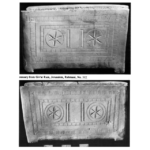
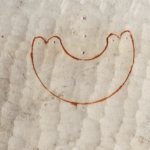
One wide side of the ossuary displays a rectangular frame symbolically and schematically representing a building. The building has openings in the roof, in the walls, and in its base. At the center of the building “floats” a semi-circular form of unique design.
The floating form may symbolize the “Wing of the Shekhinah” - the divine presence (“Holy Spirit”). Since Jewish tradition prohibited the depiction of God in art, this image provided a symbolic means of representing divine presence, signifying that God was granting protection to the deceased.
Alternative interpretations proposed for the hovering object - such as a crown, piece of jewelry, pendant, or architectural element - are implausible and unsupported by any known parallels. A comprehensive and systematic review of Jewish, Hellenistic, and Roman art further confirms the absence of parallels, underscoring the deliberate originality of the motif.
The building may be identified, by means of additional motifs on the ossuary, with the Temple (House of Yahweh) in Jerusalem. These motifs include the two columns at the entrance to the Temple in Jerusalem; the meander on the other long side, known from the Herodian Temple complex; and the amphora, a sacred vessel for libations of wine and oil in the Temple.
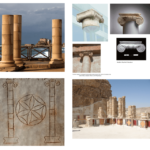
Two tall columns with Ionic capitals
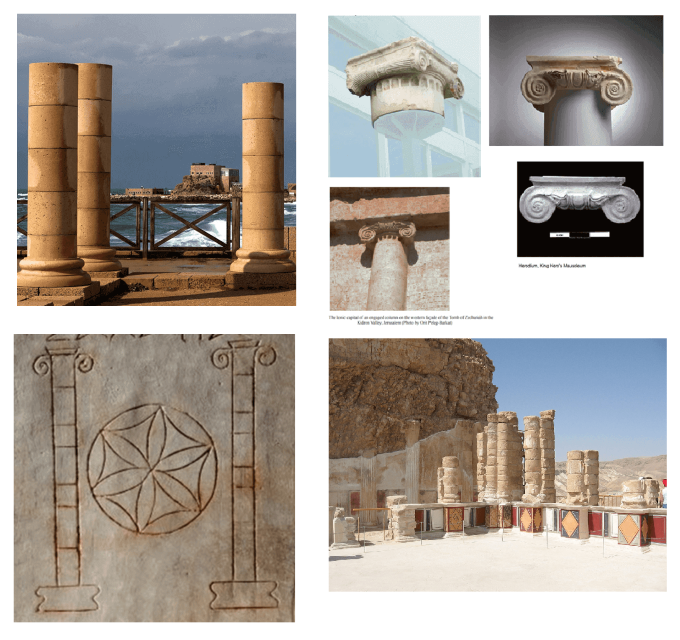
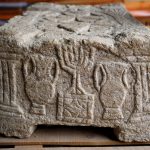
On one narrow side, two tall columns are depicted, each composed of several drums, with bases and Ionic capitals. Their free-standing position at the front of the building recalls the biblical description of the two bronze columns, Jachin and Boaz, erected by Solomon at the entrance of the First Temple - a tradition unique to the Temple in Jerusalem.
In Greek and Hellenistic architecture, and later in Roman architecture, temple façades always included multiple columns (4, 6, 8, or more) that supported an entablature and a pediment. Temples were always defined by a colonnade, never by an isolated pair of free-standing columns. The very depiction of two such independent columns therefore strongly point to the biblical–Jewish tradition of Jachin and Boaz, rather than to Greco-Roman architectural conventions.
Josephus, when describing Herod’s vast portico (στοά, stoa) south of the Temple, speaks of 162 Corinthian columns arranged in four rows, each carved from a single enormous stone. These, however, belonged to the surrounding porticoes of the Temple Mount complex, not to the Temple building itself, and they differ fundamentally from the tradition of two free-standing entrance columns.
Segmented columns, composed of drums, are known from Herodian monumental architecture in Caesarea, Masada, and Herodium, major projects of King Herod who also rebuilt the Jerusalem Temple. It is thus entirely plausible that the ossuary depiction deliberately combines the unique biblical tradition of the 2 columns in front of the temple, with the familiar architectural vocabulary of Herodian Jerusalem, producing a symbol readily recognizable to contemporary viewers as an allusion to the Temple façade.
Rosette
Between the two columns is a six-petaled rosette, a common symbol on Jewish ossuaries.
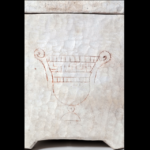
Amphora
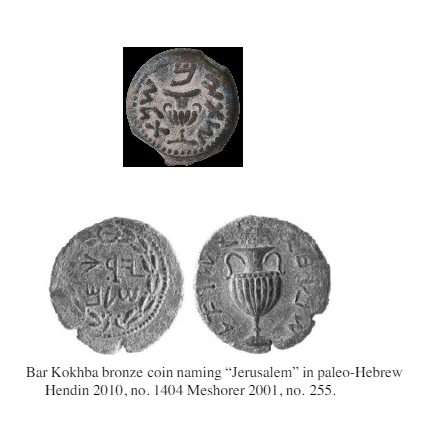
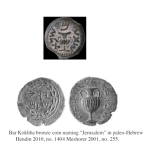
The opposite narrow side bears a large amphora. Decorations of jars and amphorae are known from ossuaries and from Jewish coins from the Hasmonean period through the Great Revolt (70 CE). The amphora was a sacred vessel for libations of wine and oil in the Temple, representing ritual and purity. Scholars, including Prof. Rachel Hachlili, have suggested that the amphora also conveyed associations with eternal life or resurrection. Its placement here, on a prominently decorated ossuary, strengthens the symbolic connection with Temple ritual and the hope of resurrection.
Geometric meander
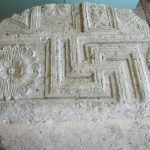
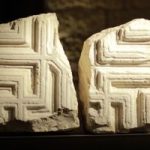
The other wide side of the ossuary displays a continuous meander design, reminiscent of motifs known from Herodian Temple stones uncovered in the Temple Mount excavations (see photos). To date, such a meander pattern has not been found on any other building in the Land of Israel from the Early Roman period, apart from the stones of the Temple complex itself. This unmistakable echo of Temple ornamentation ties the ossuary still more firmly to the sacred sphere.
Two crescents
Particularly unusual is the motif of two crescents, symbolizing renewal and resurrection, resonating with Jewish lunar tradition and the “Blessing of the Moon.” The use of paired crescents, unparalleled in the ossuary corpus, again indicates deliberate symbolic intent.
Synthesis of the motifs
Each motif on the ossuary might, when viewed in isolation, be considered “universal” or open to different interpretations. Yet their true significance lies in the way they converge and the contextual logic they create.
The semi-circular floating form (the “wing”) has no parallels in Greek, Hellenistic, or Roman art. Here it is depicted within a building with openings in its walls and roof, its façade marked by two free-standing columns - a type entirely foreign to Greco-Roman temples but distinctive of the Jerusalem Temple. Added to this are the meander design, reminiscent of the Temple of Jerusalem ceilings, and the amphora, a sacred ritual vessel. The probability that this ensemble is coincidental is extremely low. Taken together, these elements lead almost inevitably to the conclusion that the decoration evokes the Jerusalem Temple and the “Wing of the Shekhinah.”
The Name: Ζαχαρίας (Zacharias) in Greek
The ossuary bears a carefully incised inscription in Greek: Ζαχαρίας (Zacharias = Zechariah). The inscription was engraved with precision by a professional stone engraver, probably at the workshop where the ossuary was made. Unlike most inscriptions, which were hastily scratched inside dark burial caves, this one is carefully executed - attesting to the importance of the deceased. Indeed, only about 2% of ossuary inscriptions were planned and carefully executed outside the burial caves, rather than being improvised inside them. This fact further emphasizes the special status of the deceased and the deliberate preparation invested in his commemoration.
The inscription records a single name only, unlike most ossuary inscriptions where the father’s name is also given, suggesting that the deceased was identifiable by his personal name alone.
Greek was the dominant language of commerce and culture, and about 30% of inscribed ossuaries bear Greek inscriptions. Priests of the Temple are known to have used Greek, and even to have borne Greek names. Several high priests are recorded with such names: Jason (Ἰάσων, Josephus notes that ‘Yeshua' changed his name to Jason), Menelaus (Μενέλαος), and Alcimus in the 2nd century BCE. Members of the Oniad and Hasmonean dynasties likewise bore Greek names, such as Onias (Ὀνίας), Aristobulus, Alexander Jannaeus, and John Hyrcanus. In the Herodian period we find Ananelus and Simon ben Boethus. In the 1st century CE there were also Theophilus ben Ananus, and high priests rendered in Greek as ‘Jesus’ (Ἰησοῦς) son of Damneus and ‘Jesus’ son of Gamaliel.
Zacharias the priest is mentioned in the New Testament solely under the Greek form Ζαχαρίας.
Frequency and rarity of the name
Among some 650 inscribed ossuaries published to date, the name Zechariah/Zacharias appears only on four: twice in Hebrew and twice in Greek (ΖΑΧΑΡΙΟΥ). This means it was very rare, borne by only about 0.5% of males.
The spelling Ζαχαρίας, exactly as in the New Testament, is otherwise unattested archaeologically - making this ossuary unique. The statistical weight of this uniqueness is considerable, strongly favoring the identification with the priest of the New Testament.
Personal and Symbolic Design – and Attribution
The decorations clearly display a set of highly personal symbols. Since Judaism prohibited human figures, the decorators used symbolic motifs:
- Priesthood in the Temple: two columns, a meander motif, and the amphora.
- Divine presence: the “Wing of the Shekhinah.”
- Jewish identity and hope: crescents and amphora, symbols of resurrection.
The combination of these motifs suggests that the deceased Ζαχαρίας served as a priest in the Temple, and that the story of divine revelation to him was widely known. According to Luke 1:65, the divine grace granted to Zechariah the priest, father of John the Baptist, and his encounter with the angel Gabriel “was spread abroad throughout all the hill country of Judea.” Based on the cumulative evidence - the rarity of the name, the precise New Testament orthography, and the exceptional iconographic program - the probability that the deceased was Zechariah the priest, father of John the Baptist, must be regarded as very high.
Conclusion
The ossuary of Zechariah/Zacharias is unique: decorated on all sides, bearing a rare name in a singular orthography, and combining motifs tied to Temple, priesthood, divine presence, and resurrection. Taken together, these elements provide a compelling case that the ossuary belonged to a priest of the Jerusalem Temple, a figure of exceptional status, revered in his community.
Another Zechariah?
One possible objection is that the name, though rare, was not unique. Yet the precise spelling Ζαχαρίας appears nowhere else on an archaeological artifact. This, together with the extraordinary iconographic program, greatly reduces the probability that the ossuary belonged to another, otherwise unknown Zechariah. The convergence of rarity of the name, uniqueness of the orthography, and the decorated program makes the likelihood of an alternative attribution minimal. It is therefore entirely plausible that the ossuary was specially commissioned to commemorate Zechariah the priest, remembered for his divine encounter - a memory naturally preserved by members of the early Jewish-Christian community.
Final Note
What emerges, then, is not a single isolated argument but a consistent pattern: the name, its rare orthography, the exceptional decoration, and the symbolic program all converge in a way unparalleled in the ossuary corpus. Taken together, these lines of evidence strongly support the identification of this ossuary with Zechariah the priest, father of John the Baptist - the man whose vision of the angel Gabriel and the divine favor granted to him were “spread abroad throughout all the hill country of Judea,” preparing the way for the message of the Messiah.