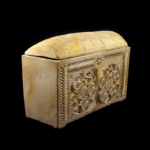
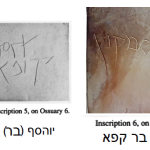
A magnificent ossuary inscribed YoHaSef Bar Kopa (or Kopha) = YoHaSef son of Kopa (or Kopha). This ossuary was wrongly attributed to Caiaphas (Καϊάφας), the Jewish High Priest (around 33 AD) who according to the gospels, organized a plot to kill Jesus, who famously presided over the Sanhedrin trial of Jesus. Excavated at a tomb cave at south of Abu Tur (Nahal Etzel) Jerusalem. The early Roman period
barcode
73960
Site item id
19707
Collection name
Item period
The Misattributed Ossuary of “Caiaphas”
A richly decorated ossuary bearing two Aramaic inscriptions was discovered in southeast Jerusalem (Nahal Etzel). The inscriptions read:
- “Yohesef (or Yohasef) bar (= son of) Kpa” (on the narrow side)
- “Yohesef (bar?) Kopa” (= Yohesef son of Kopa) (on the back side)
The archaeologists who discovered it suggested that the ossuary belonged to the High Priest Joseph, called Caiaphas (Καϊάφας), who is mentioned in the New Testament as head of the Sanhedrin that condemned Jesus to crucifixion. This identification, later adopted by the Israel Museum where the ossuary is now exhibited, is almost certainly mistaken.
According to the scholarly publication of the ossuary, and as repeated on the Israel Museum label, the inscription was interpreted as “Yosef son of Caiaphas (Kipa).” Yet the Aramaic letters “KPA” can be read in multiple ways: Kapa, Kipa, Kupa, Kepa, Kopa, Kafa, Kifa, Kufa, Kefa, Kofa, and more. However, since on the back of the ossuary the name KPA is clearly written as Kopa, the possible readings are limited exclusively to Kopa, Kupa, and Kofa (and not Kipa).
It seems that both the original publishers of the ossuary and the museum selected the “Kifa” reading in order to connect the artifact with the High Priest Caiaphas, who is called by the Roman historian Josephus “Kifa, called Caiaphas” — one of the most significant figures in the Gospel narrative. However, all the evidence indicates that the deceased’s name was Yohesef son of “Kopa.” In Aramaic, Kopa means basket, box, or chest; it likely originated as a nickname, perhaps for someone who manufactured or transported such containers.
The High Priest Caiaphas in Josephus
In Antiquities XVIII.35, Josephus’ Greek text reads:
Ἰωσὴφ ὁ καλούμενος Καϊάφας
Iōsēph ho kaloumenos Kaiaphas
= “Joseph, who was called Caiaphas.”
Thus, in Josephus it is explicitly an epithet (“called Caiaphas”), not “bar/ben Caiaphas.” He never writes Ἰωσὴφ τοῦ Καϊάφα (= Joseph son of Caiaphas) in the extant text.
Josephus consistently expresses filial relationships in Greek using the genitive case with tou (“of”):
- Antiquities XX.200 – “Ananus the son of Ananus” = Ἀνάνου τοῦ Ἀνάνου
- Jewish War VI.114 – “Jesus, son of Sapphias” = Ἰησοῦς τοῦ Σαπφίου
When Josephus means “X son of Y,” he always uses this Name τοῦ Name formula. He never simply places two names side by side.
Problems with the Ossuary Attribution
On the ossuary itself, the inscription on the narrow side reads: “Yohesef bar KPA” (= Kapa, Kafa, Kipa, Kifa, etc.). However, the inscription on the back side clearly reads: “Yosef bar Kofa (or Kopa),” not “Kifa.” This reading is unambiguous and beyond dispute.
Another ossuary, reportedly discovered (according to the Israel Antiquities Authority) in the Valley of Elah area near Beth Shemesh, also clearly bears the name “Kopa.” Its inscription reads:
“Mariam daughter of Yeshua son of Kopa (or Kofa), priest of Ma‘aziah from Beth Imri.”
This inscription was published by Prof. Yuval Goren and Prof. Zissu, but they mistakenly transcribed the name “Kofa” as “Kifa.” However, their own article included a drawing of the inscription in correct form, and in this drawing it is clear that the name must be read “Kopa” or “Kofa,” not “Kifa.”
Furthermore, in the burial cave where the decorated ossuary was found, there was no evidence whatsoever linking it to the High Priest’s family. On the contrary, an unusual pagan feature was discovered: a coin placed in the mouth of the deceased. It is highly implausible that such a pagan ritual would have been practiced in the household of the Jewish High Priest.
Conclusion
The attribution of the inscription “Yohesef bar Kopa” to the High Priest Caiaphas is therefore an artificial construct, lacking factual basis, created solely to associate the ossuary with a famous historical figure: the High Priest at the time of Jesus.